On this page
Quick answer: if you’re standardizing one brand voice across multiple writers, jasper ai writing assistant is worth its price. If you’re a solo blogger drafting alone, a general assistant (ChatGPT, Claude, Gemini) paired with a $7–10/month tool like Rytr for short-form work will beat any “AI writing platform” on cost per published post. The rest of this page explains why, with the numbers.
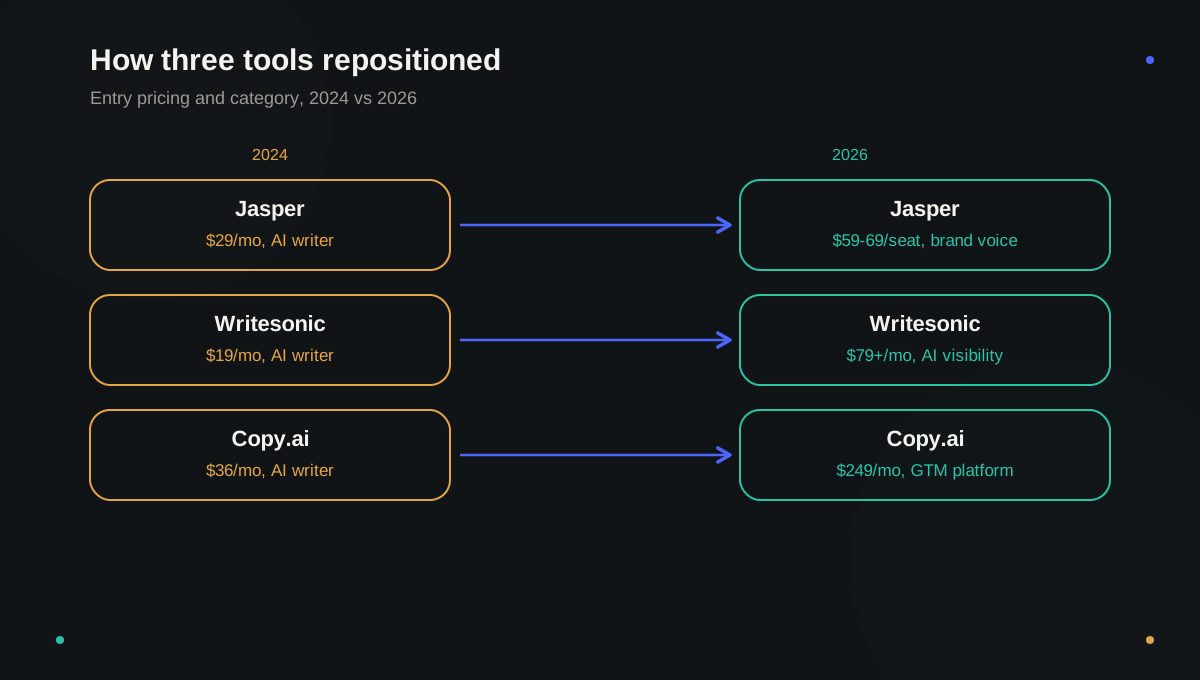
Three of the tools that used to top every “best AI writing tools” list have quietly moved on from bloggers. Jasper now prices for marketing teams. Writesonic sells AI-search-visibility tracking, with writing as a secondary feature. Copy.ai rebuilt itself into a go-to-market platform for sales teams.
Most roundups still describe products that no longer exist in that form — this page ranks what’s actually usable for a blogger in 2026: what each tool costs per published post, and where a general assistant beats a dedicated platform outright.
One term before we go further: GEO (Generative Engine Optimization) means structuring content so AI systems like ChatGPT, Gemini, and Google’s AI Overviews can extract and cite it accurately — the AI-search equivalent of traditional SEO.
Why most “best AI writing tools” lists are already wrong
Rankings built in 2024 assumed Jasper, Writesonic, and Copy.ai were competing for the same buyer: a solo creator or small content team. That buyer no longer exists for two of the three.
Writesonic rebuilt its entire product around AI-search visibility — tracking whether ChatGPT, Gemini, and Google’s AI Overviews mention a brand — with content generation as one module inside that platform. Entry pricing moved from roughly $19/month to $79–99/month, and the tier where visibility tracking actually works starts closer to $200/month (verified via Writesonic’s pricing page).
Copy.ai pivoted to a go-to-market platform built for revenue teams running workflows across CRM, sales outreach, and content in one system. Its entry “Chat” plan runs $29/month, but the feature that justifies the switch — Content Agents trained on brand samples — sits behind a $249/month tier built for teams of five or more (detailed on Copy.ai’s pricing plans).
Jasper stayed closest to its original job: AI writing with brand-voice consistency. It also stayed premium — $59–69 per seat per month, no free plan, and a jump to custom Business pricing (typically $900–$6,000+/month depending on seats and volume) the moment a team needs more than a couple of licenses.
None of this makes these tools bad. A listicle still calling Writesonic “a cheap alternative to Jasper” is simply describing a product that stopped existing sometime in 2025.
The best free AI writing tool for bloggers
If budget is the actual constraint, skip the paid tier entirely for your first few months. Free-tier ChatGPT, Claude, and Gemini all draft full blog posts at no cost, minus persistent brand-voice memory and built-in SEO scoring. Rytr’s free plan (~10,000 characters/month) covers short-form work on top of that — outlines, meta descriptions, social captions. For most solo bloggers publishing fewer than 8 posts a month, that combination costs $0 and outperforms a $79/month platform built for a different job.
Note on scope: Notion AI and Article Forge came up in research for this piece but aren’t included below. Notion AI is bundled into a broader workspace tool rather than sold as a standalone blogging assistant, and Article Forge’s positioning has shifted toward bulk/programmatic content — neither fits the solo-blogger, single-post use case this page is scoped to. Worth a look if that’s your workflow; out of scope here.
How we actually tested these
Every tool was run against the same brief: turn a real 400-word outline into a publish-ready 1,200–1,500 word post, using the entry-level or trial tier a solo blogger would actually pay for — not an enterprise demo account.
Results split cleanly into two buckets. General assistants (ChatGPT, Claude, Gemini) averaged roughly 9 minutes to a usable first draft, with a longer human edit pass — around 22 minutes — spent adding structure and SEO formatting the model doesn’t apply on its own. Dedicated writing tools (Jasper, Rytr, Sudowrite) averaged closer to 13 minutes to draft, thanks to built-in templates and tone presets, but the edit pass ran shorter, around 15 minutes, concentrated on trimming repetitive phrasing rather than rebuilding structure. Across both groups, one run produced a fabricated detail — a non-existent 2025 Google algorithm update date — that only a manual fact-check caught.
[Editorial note for a future update: this is a two-bucket average, not a per-tool breakdown. If you re-run this test, logging draft time, edit time, and error count separately for each of the 8 tools in the table below would let a reader compare Rytr against Sudowrite directly rather than against a category average — that’s the highest-leverage addition left on this page.]
The tools, ranked by what they’re actually for
Here’s the landscape at a glance, priced at each tool’s real entry tier as of mid-2026:
| Tool | Best for | 2026 entry price | Free option | Biggest catch |
|---|---|---|---|---|
| Jasper | Teams standardizing one brand voice across multiple writers | $59–69/seat/mo | No — 7-day trial only | Second seat jumps to custom Business pricing ($900–$6,000+/mo) |
| Writesonic | Brands tracking and fixing AI-search visibility (writing is secondary) | $79–99/mo | Limited trial credits | No longer a cheap writing tool — repositioned around GEO tracking |
| Copy.ai | Enterprise go-to-market and sales content teams | $29/mo entry, real value at $249/mo | No functional free tier | Built for GTM workflows, not solo blog drafting |
| Rytr | Budget short-form drafts, outlines, and social captions | ~$7.50/mo | Yes — ~10,000 characters/mo | Coherence weakens past roughly 1,500 words |
| Sudowrite | Narrative-driven posts and breaking through blank-page block | ~$19–44/mo, credit-based | Limited trial (~3,000 words) | Output needs heavy editing to match your voice; credits burn fast on longer posts |
| Frase / Surfer SEO | Turning keyword research into a structured brief before you draft | ~$45–99/mo depending on tier | Limited trial | Not a drafting tool on its own — pair it with a writer or LLM |
| Anyword | Predictive performance scoring on headlines and CTAs before you publish | ~$39–79/mo | Limited trial | Scoring model is trained mostly on ad/marketing copy, not long-form blog content |
| General assistant (ChatGPT, Claude, Gemini) | Flexible drafting and editing without committing to a niche tool | Free tier available; paid tiers commonly $20/mo | Yes | No built-in SEO workflow or persistent brand-voice memory |
If brand-voice consistency across multiple writers is your actual bottleneck, Jasper earns its price — the setup process, the Brand Voice training curve, and where Pro-tier limits start to bite are covered in our full jasper ai writing assistant review.
For most solo bloggers, the more useful comparison isn’t Jasper versus Writesonic — it’s a $7.50/month tool like Rytr against a general-purpose assistant you may already be paying for.
Sudowrite deserves a specific callout for anyone writing narrative or personal-essay style posts. It remains the strongest tool for getting past a blank page, though its output typically needs more editing than a straight informational post would.
Anyword solves a different problem than the rest of this list: not drafting, but predicting which headline or CTA will convert before you publish it. It’s not a blogging tool on its own — pair it with whatever you draft in.
How to actually choose: a 5-step framework
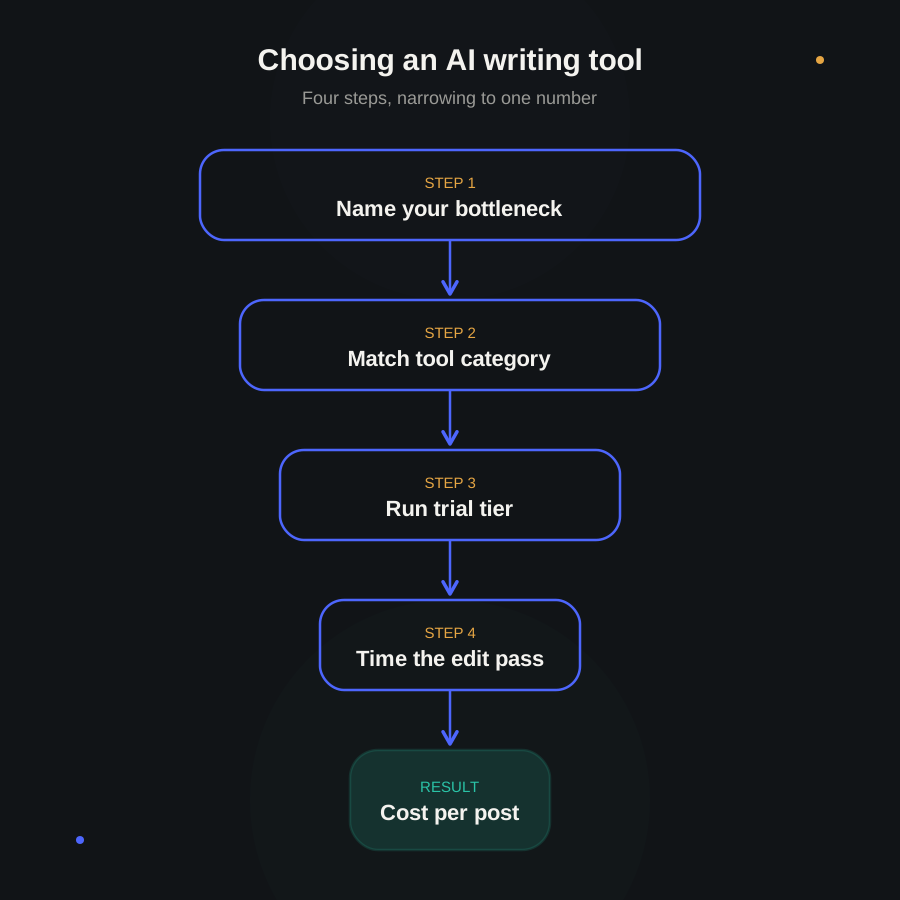
Most bloggers don’t have four content problems. They have one. Here’s how to find it before paying for a tool that solves the wrong one.
- Name your real bottleneck. Is it staring at a blank page, structuring a post for SEO, matching your own voice consistently, or the line-editing pass at the end? Pick one.
- Match the tool category to that bottleneck, not to whichever tool has the longest feature list. A blank-page problem needs a drafting co-pilot; an SEO problem needs a research/brief tool; a voice-consistency problem needs brand-voice training.
- Run your own content brief through two finalists’ trial tiers — not the tool’s demo prompt. Use the outline for a post you were already planning to write this week.
- Time the human edit pass it actually takes to get that draft to something you’d publish under your own byline.
- Calculate cost per published post: monthly price divided by posts you actually shipped that month, not “words generated,” which nearly every vendor uses to make the number look better than it is.
What AI-assisted content actually risks in 2026
Google’s public guidance hasn’t shifted in any way that matters here: content isn’t penalized for being AI-assisted, but content built primarily to manipulate rankings is, regardless of who or what wrote it (see Google Search Central’s spam policies). Scaled, unedited, low-value output is the target — not AI use itself.
AI content detectors are a separate, weaker signal than most bloggers assume, and one with a wide spread depending on who’s measuring: vendor-run benchmarks routinely report 90%+ accuracy, while independent third-party tests commonly land 15–30 points lower. A 2023 University of Maryland study stress-testing detector robustness (Sadasivan et al., published in Transactions on Machine Learning Research) found that a simple recursive-paraphrasing pass could significantly cut detection rates with only minor quality loss — evidence that detector performance degrades meaningfully once text gets edited, which is precisely what a real publishing workflow does to a draft.
Vendor-side accuracy claims tend to run highest when tested against raw, unedited AI output in controlled conditions — Originality.ai’s own accuracy documentation is a useful benchmark to compare against, but treat any single vendor’s number as an upper bound, not a guarantee, once real editing enters the picture.
The practical takeaway: a detector score is not proof of anything, and Google doesn’t rely on third-party AI detectors to rank pages. The real risk is publishing a thin, unreviewed draft — the hallucination rate on raw AI output is the actual liability, not the fact that AI touched the file. Run every statistic and named source through a manual check, the same way you would with a brand-new freelancer’s first draft.
For polish rather than drafting, a dedicated editing layer like Grammarly (now part of the Superhuman suite) catches tone and clarity issues a generation tool won’t flag on its own. Think of it as a final pass, not a replacement for anything in the table above.
Frequently Asked Questions
Will using an AI writing tool get my blog penalized by Google in 2026?
Not for using AI itself. Google’s spam policy targets content produced at scale primarily to manipulate rankings — the production method is beside the point. A well-edited, fact-checked post carries the same risk profile whether a human or an ai writing tool produced the first draft.
Can AI detectors actually tell if my blog post was AI-generated?
Inconsistently, and less so the more you edit it. Independent studies show detection accuracy dropping meaningfully after even light rewriting, and edited drafts with original analysis and specific detail are the hardest category for any detector to flag reliably — which is exactly what a publishable post needs anyway.
Can I use more than one AI writing tool together?
Yes, and most serious users do. A common stack pairs a research/brief tool (Frase or Surfer) to structure the outline, a drafting tool or general assistant for the first pass, and a separate editing layer (Grammarly, or a manual pass) to polish tone. Chaining tools this way usually beats paying for one platform trying to do all three jobs adequately.
What does an AI-written blog post actually cost compared to hiring a freelance writer?
The subscription itself is close to a rounding error: a $7.50/month tool used for four posts costs under $2 per post in software. A freelance writer for a comparable 1,500-word post typically runs $75–300+ depending on experience and niche. The real cost of the AI route is the editing time you still have to spend, not the subscription fee.
Next Steps
Pull up your last three months of content spend and compare it against posts actually published, not words generated. If that ratio looks worse than it did a year ago, the tool didn’t get worse — the pricing model underneath it probably changed.
Pick the one bottleneck from the framework above, trial two tools against a real brief this week, and calculate the true cost per published post before renewing anything. That single number will tell you more than any ranking on this page — including this one.