On this page
- What "Content Creation Tools" Actually Cover in 2026
- Tools We've Tested Directly on Client Work
- Tools We Evaluated on Documentation and Independent Reviews
- Comparing the Stack: What Each Tool Actually Delivers
- A Framework for Choosing Between Content Creation Tools
- Where AI Content Creation Tools Still Fail
- Frequently Asked Questions
- Next Steps: Auditing Your Own Content Pipeline
Most lists of content creation tools rank software by feature count. That tells you nothing about what lands in your folder at the end of the day — a rough draft, a finished asset, or a client-ready deliverable. This piece ranks tools by output: four we’ve run on paid client production work, with the exact time and cost impact measured, plus four more we evaluated against vendor documentation and independent reviews and have clearly labeled as such. If you run content, marketing, or creative production and need to know which tool replaces which step in your pipeline, this is that breakdown.
What “Content Creation Tools” Actually Cover in 2026
The category stopped being “AI writing assistants” a while ago. A modern stack for content marketing tools spans four distinct jobs: ideation and scripting, visual generation, audio production, and distribution or outreach. Treating all four as one category is why most buying decisions go wrong — a tool that’s excellent at drafting text is usually mediocre at generating usable visuals, and vice versa.
We run a production agency that builds explainer videos for B2B clients, which means our stack has to move a concept from a one-line brief to a finished video without losing days to revisions. Below is exactly which ai content creation tools sit in that pipeline, in the order they’re used, followed by additional tools we evaluated against public documentation and independent reviews rather than direct client work.
Tools We’ve Tested Directly on Client Work
Scripting & Ideation: ChatGPT Plus and Claude
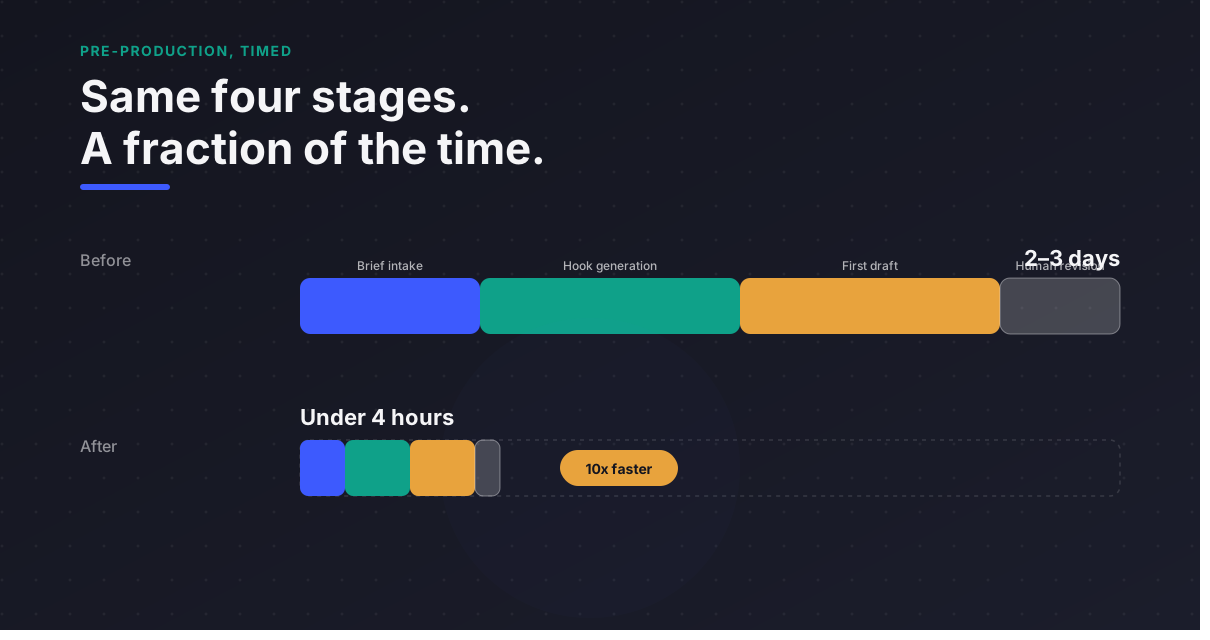
We use both ChatGPT and Claude heavily for brainstorming explainer video concepts and structuring first-draft scripts. The workflow is specific: we feed the model a client’s brand persona, tone guidelines, and target-audience pain points, then generate five to eight hook variations before a human writer picks a direction.
Pre-production research and initial script drafting dropped from two to three days down to under four hours. That’s not the AI writing the final script — it’s the AI collapsing the blank-page phase, which used to be the slowest part of the process.
Where this breaks: neither model reliably holds a 10+ page script’s structure without contradicting an earlier plot point or tone shift. We never skip the human pass on anything client-facing.
Visuals & Storyboarding: Midjourney
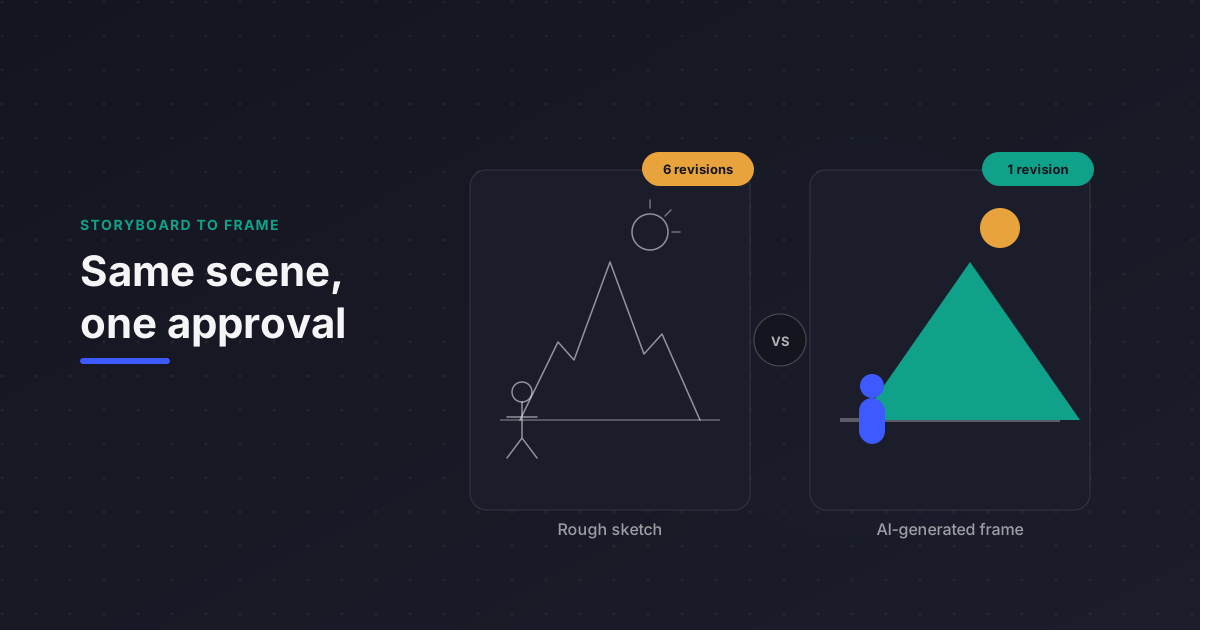
Before illustrators touch a project manually, we run mood boards and style frames through Midjourney. Clients see high-fidelity visual concepts instead of rough thumbnail sketches — a meaningful shift in how confidently they can approve a direction.
Client approval time on visual styles dropped by almost 50%. The reason isn’t that Midjourney’s output is final-quality (it isn’t, for brand-specific character work) — it’s that clients stop having to imagine what a rough sketch will look like finished. They’re reacting to something that already looks close to done.
Audio and Voiceover: ElevenLabs
We generate scratch-track voiceovers with ElevenLabs before animation work begins. Animators sync their timing to the AI track, and only once the animation is locked do we bring in a human voice actor to record the final audio.
This saved hundreds of dollars per project in voiceover revisions, because pacing and timing get locked against AI audio first. The human voice actor records once, against a finished animation, instead of recording multiple passes while animators guess at timing.
None of these three tools replaced a role. Each one removed a specific bottleneck — the blank page, the rough sketch, the guessed timing — that used to cost days.
Tools We Evaluated on Documentation and Independent Reviews
We haven’t run these on paid client deliverables ourselves, so the notes below reflect vendor documentation and third-party reporting rather than our own measured results. Worth knowing before you shortlist them.
Copy.ai targets the same long-form drafting job as Jasper but leans harder into workflow automation — chaining prompts across a full content brief instead of generating one asset at a time. Reported strength is repetitive, template-driven copy (ad variations, product descriptions) at volume.
Surfer SEO isn’t a generation tool at all — it’s a content-optimization layer that scores a draft against top-ranking pages for a target keyword and flags gaps in entity coverage. Teams typically pair it with a drafting tool rather than use it standalone.
Descript handles audio and video editing through a text-based interface — cutting video by editing a transcript. For teams doing talking-head or podcast-style content, this replaces manual timeline editing in a way our scratch-track workflow with ElevenLabs doesn’t address.
Runway generates and edits video directly from text or image prompts. Positioned closer to production-stage video generation than our storyboarding use of Midjourney, with the tradeoff of less control over exact brand consistency.
Comparing the Stack: What Each Tool Actually Delivers
| Tool | Category | What It Actually Produces | Measured Impact | Still Needs a Human For |
|---|---|---|---|---|
| ChatGPT Plus / Claude | Scripting & ideation | First-draft hooks, script structure | Drafting time: 2-3 days → under 4 hours | Final script tone, long-form structural consistency |
| Midjourney | Visuals & storyboarding | Mood boards, style frames | Client approval time down ~50% | Brand-accurate character design, final illustration |
| ElevenLabs | Audio / voiceover | Scratch-track voiceover for timing | Cut voiceover revision costs significantly | Final voice recording, emotional delivery |
| Jasper | Long-form writing | Structured blog and landing page drafts | Fastest for high-volume, brand-voice-guided text | Fact-checking, source citation, final edit |
| Copy.ai | Long-form / template copy | Chained drafts across a content brief | Not independently measured by us | Brand-voice consistency at scale |
| Surfer SEO | Content optimization | Gap analysis against ranking pages | Not independently measured by us | Judgment on which flagged gaps actually matter |
| Descript | Audio/video editing | Transcript-based video cuts | Not independently measured by us | Pacing decisions, final color/sound mix |
| Runway | Video generation | Text/image-to-video clips | Not independently measured by us | Brand consistency across scenes |
If your primary need is high-volume long-form writing rather than video production, that’s a different tool entirely — we cover how jasper ai writing assistant performs specifically for structured, brand-voice-guided drafting in a separate breakdown, since scripting tools and long-form writing tools solve different problems even though they’re often grouped under the same category.
A Framework for Choosing Between Content Creation Tools
Most teams pick tools by trying whatever’s trending. A faster method: map the tool to the specific bottleneck it needs to remove, not the category it’s marketed under.
- Identify the slowest stage in your current pipeline. Time each phase of a real project — brief, draft, review, revision, final output — before evaluating any tool against it.
- Match the tool to that single stage, not the whole workflow. No current tool reliably owns ideation, visuals, audio, and distribution at once without a human checkpoint between each.
- Test on a real deliverable, not a demo prompt. Generic demo results rarely reflect what happens with your actual brand guidelines, client constraints, and format requirements.
- Measure the specific number that stage was costing you — hours, revision rounds, or dollars — before and after.
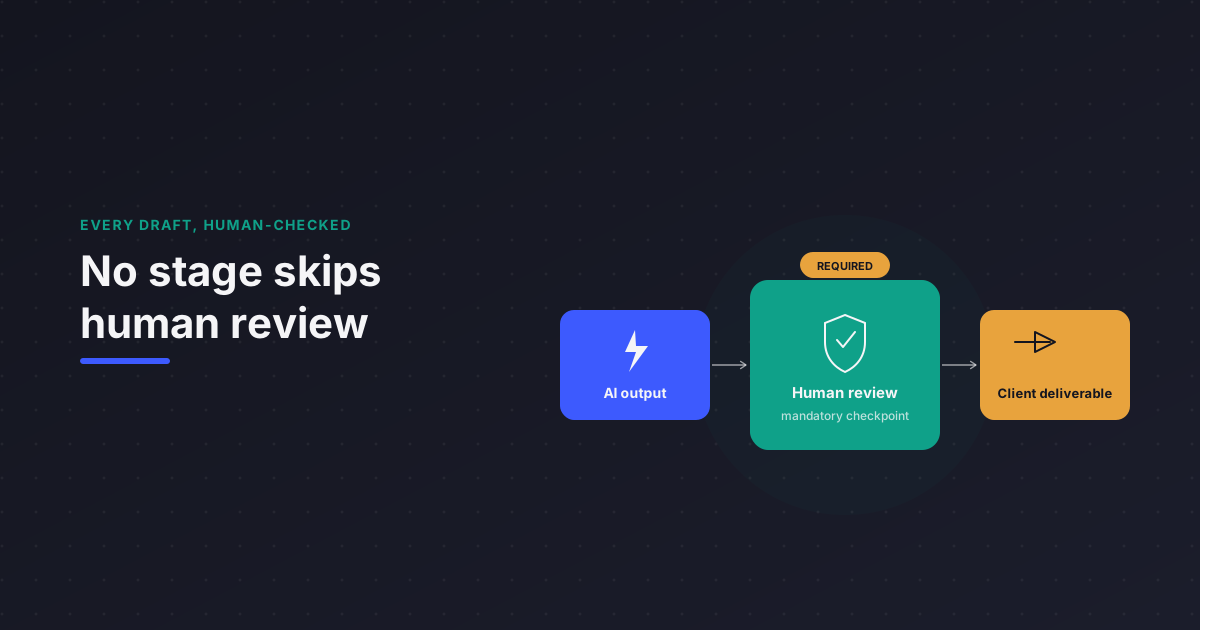
- Keep the human checkpoint at the handoff, not inside the AI step. The failures we’ve seen in other agencies’ workflows almost always come from skipping the review between AI output and the next production stage.
This is the same logic that applies broadly to evaluating ai-powered content creation tools: the tool’s job is to remove a measured bottleneck, not to run the whole pipeline unsupervised.
Where AI Content Creation Tools Still Fail
Being direct about this matters more than the wins above. Language models lose structural consistency past a certain script length. Midjourney can’t hold a consistent character design across multiple scenes without significant manual correction. ElevenLabs’ scratch tracks are timing tools, not final assets — using them as final voiceover is a quality downgrade clients notice immediately.
The failure pattern across all of the tools above is the same: treating AI output as a finished deliverable instead of a faster starting point. Every measurable result in this article came from AI shortening a specific phase, not from AI replacing the phase entirely.
Frequently Asked Questions
Can AI-generated scratch-track voiceovers be used as final audio in client deliverables?
No, not for paid production work. ElevenLabs scratch tracks are built for timing and pacing reference so animators can sync their work before the final recording. Using them as final audio typically reads as synthetic to viewers and undermines the perceived production quality, even when the script and animation are strong.
How much of a script can ChatGPT or Claude reliably draft before a human needs to intervene?
Both models handle hook generation and initial structure well, especially when fed a specific brand persona and tone brief. Structural consistency degrades on scripts beyond roughly a page or two — contradictions in tone, pacing, or callback references start appearing, which is why a human writer reviews every draft before it moves to production.
Does using Midjourney for storyboarding replace the need for a human illustrator?
No. Midjourney generates mood boards and style frames fast enough to speed up client approval, but it can’t consistently reproduce a specific brand character or maintain visual continuity across a full storyboard sequence. Illustrators still build the final frames; Midjourney’s role is compressing the concept-approval stage that used to run on rough sketches.
Next Steps: Auditing Your Own Content Pipeline
If you’re evaluating content creation tools for your team, don’t start with a tool comparison — start by timing your actual pipeline stage by stage. The tools above only produced measurable results because we knew exactly which bottleneck each one needed to remove before we adopted it.
If you want a second set of eyes on where your current content or video production process is losing time, that’s worth an outside audit before you add another subscription to the stack.